
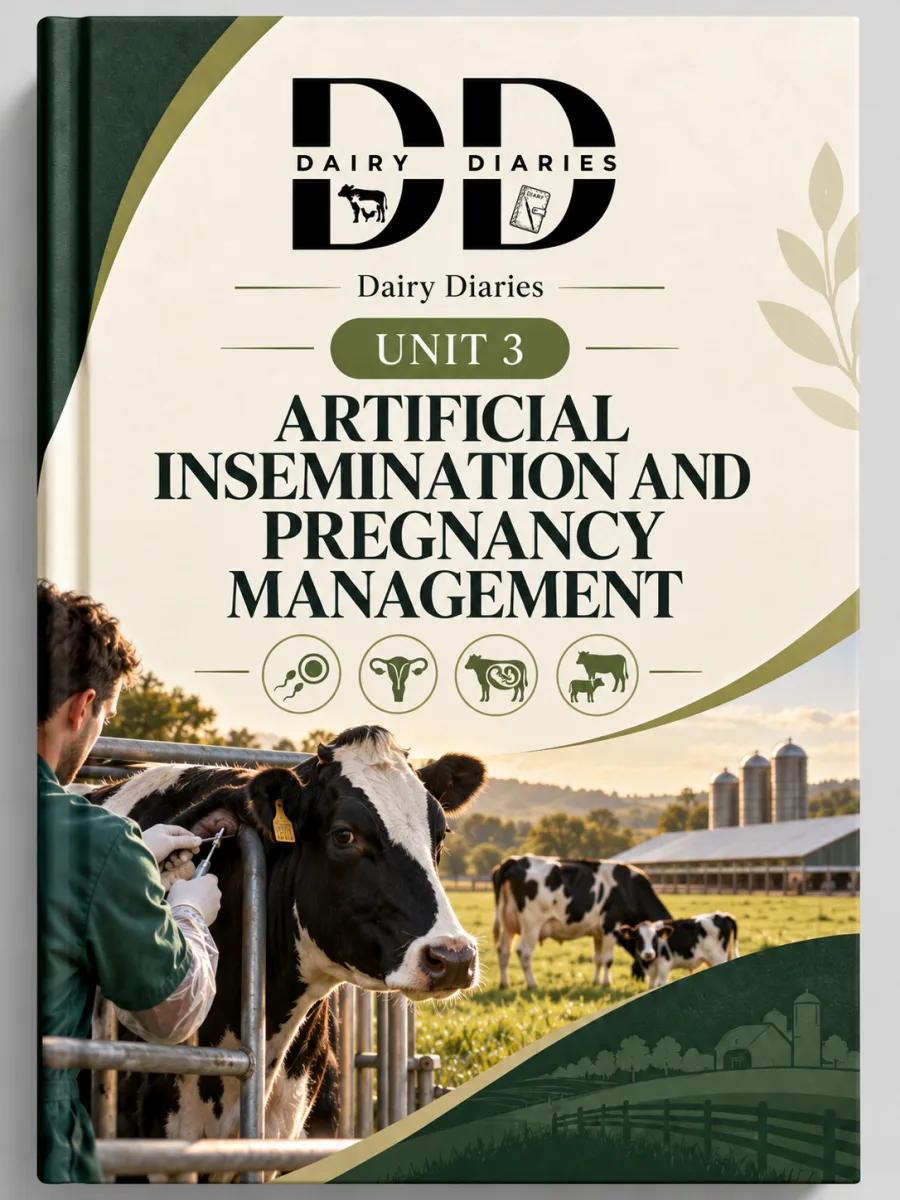
Premium Field Guide
Artificial Insemination and Pregnancy Management
₹399one-time
Available inతెలుగుEnglish
One purchase includes every language listed, and any added later.
Understand the principles of livestock reproduction, artificial insemination, and pregnancy care. This unit introduces reproductive anatomy, estrus detection, insemination practices, pregnancy diagnosis, and management of pregnant animals to support better reproductive efficiency and healthier offspring.
See what's inside — 2 chaptersInstant Access
Secure Payment
1 Year Access
Secure CheckoutPowered by Razorpay
Instant access is granted upon successful payment.
What's Inside This Book
Table of Contents
2 chapters, 83 topics
- 1.1Chapter: Animal Reproduction SciencePage 1
- 1.2SacrumPage 4
- 1.3Female Reproductive System of AnimalsPage 8
- 1.4Fallopian Tube / OviductPage 12
- 1.5Reproductive Organs of BullPage 21
- 1.6Sperm Cell (Spermatozoa)Page 24
- 1.7EpididymisPage 27
- 1.8Bulbourethral Gland / Cowper's GlandPage 34
- 1.9Functions of Accessory Sex GlandsPage 34
- 1.10Puberty or Age of PubertyPage 36
- 1.11Pituitary HormonesPage 38
- 1.12Hypothalamic HormonesPage 41
- 1.13EstrogenPage 42
- 1.14ProgesteronePage 44
- 1.15RelaxinPage 45
- 1.16Estrous CyclePage 46
- 1.17Proestrus PhasePage 47
- 1.18Estrus Phase (True Heat)Page 49
- 1.19OvulationPage 50
- 1.20Diestrus PhasePage 52
- 1.21Graafian FolliclePage 54
- 1.22Corpus AlbicansPage 55
- 1.23Corpus LuteumPage 55
- 1.24Differences in First Calving Between Indigenous and Foreign BreedsPage 59
- 1.25Estrous Cycle in LivestockPage 63
- 1.26Fertilization, Embryo Development, and ParturitionPage 65
- 1.27Estrus and Its Symptoms (Symptoms of Estrus / Heat)Page 69
- 1.28Favorable Time for Artificial Insemination (AI)Page 71
- 1.29Stages of Estrus / Heat and the Right Time for Artificial Insemination (AI)Page 73
- 1.30Reasons for Infertility and Precautions to Take During Artificial Insemination (AI)Page 77
- 1.31Proper Timing of Breeding Management Is EssentialPage 80
- 1.32Artificial Insemination with Cryopreserved SemenPage 81
- 1.33Various Stages and Technical Aspects of Artificial Insemination (AI)Page 83
- 1.34Advantages and Limitations of Artificial Insemination (AI)Page 86
- 1.35Limitations / Disadvantages of Artificial InseminationPage 88
- 1.36Artificial Insemination in Buffaloes with Concentrated Bull SemenPage 89
- 1.37Semen Evaluation ParametersPage 91
- 1.38Equipment Required for an Artificial Insemination CentrePage 93
- 1.39Centigrade ThermometerPage 97
- 1.40Liquid Nitrogen (LN₂)Page 98
- 1.41Liquid Nitrogen Container (LN₂ Container) – Temperature Differences in the Neck PartPage 100
- 1.42Artificial Insemination Gun (AI Gun)Page 104
- 1.43Handling of Semen Straws Inside the LN₂ Container NeckPage 107
- 1.44Method of Thawing Frozen SemenPage 109
- 1.45Artificial Insemination TechniquePage 114
- 1.46Artificial Insemination Procedure (Recto–Vaginal Technique)Page 118
- 1.47Precautions to Be Followed in the Recto–Vaginal MethodPage 121
- 2.1Pregnancy Diagnosis in Cattle and BuffaloesPage 123
- 2.2Internal Pregnancy Diagnosis in Animals (Per-Rectal Pregnancy Diagnosis)Page 127
- 2.3FremitusPage 132
- 2.4Various Sexual Nomenclatures of Animals, Newborns, and the Act of ParturitionPage 135
- 2.5Parturition in AnimalsPage 136
- 2.6Stages of ParturitionPage 140
- 2.7Postpartum Changes in UterusPage 143
- 2.8Hormones of the Reproductive SystemPage 145
- 2.9Main Reproductive HormonesPage 149
- 2.10Ovaries, Uterus, and Hormones Released from the TestesPage 152
- 2.11Position of the Fetus in the Pregnant UterusPage 157
- 2.12Position and Posture of the FoetusPage 163
- 2.13Posture Favorable for Natural DeliveryPage 165
- 2.14Ideal 3 P's for Normal ParturitionPage 166
- 2.15Obstetrical OperationsPage 167
- 2.16FoetotomyPage 171
- 2.17Cesarean Operation (Cesarean Section)Page 175
- 2.18Epidural AnaesthesiaPage 178
- 2.19DystociaPage 180
- 2.20Obstetrical OperationsPage 185
- 2.21Other Causes of Dystocia (Miscellaneous Causes of Dystocia)Page 188
- 2.22Dystocia Treatment (Relieving Dystocia)Page 193
- 2.23Post-Delivery Care and Management of the UterusPage 200
- 2.24Uterine TorsionPage 201
- 2.25Retention of Placenta (ROP)Page 208
- 2.26Future Problems Caused by Retention of PlacentaPage 213
- 2.27Infertility / SubfertilityPage 215
- 2.28Macerated FoetusPage 223
- 2.29EndometritisPage 226
- 2.30PyometraPage 235
- 2.31AnoestrusPage 240
- 2.32Silent Heat / Weak HeatPage 244
- 2.33Repeat BreederPage 247
- 2.34Deficiencies in the Female Animal's Reproductive System (Female Genital Tract Defects)Page 250
- 2.35Prolapse of Vagina, Cervix and UterusPage 256
- 2.36Symptoms of Prolapse (Clinical Symptoms)Page 259
Chapter and topic names only. The full book opens in your library after purchase.